
 WINCH STRAPS
 RATCHET STRAPS
 E-TRACK STARPS
 BUNGEE STRAPS
 LIGHT WEIGHT TARPS
 TARP REPAIR KITS
 TRANSPORT CHAINS AND SNOW TIRE CHAINS
 RATCHET & LEVER BINDERS
 CHAIN HOOKS AND HARDWARE
 LOAD SUPPORT
 PLASTIC CORNER PROTECTORS
 V-CORNER PROTECTORS
 STEEL CORNER PROTECTORS
 CORNER PROTECTOR PLACEMENT
 OVERSIZE LOAD FLAGS & BANNERS
 SAFETY APPAREL & ACCESSORIES
 CAB RACKS
 TOOL BOXES
 GRILLE GUARDS
 WINCH SYSTEMS
 ACCESSORIES

There is no single federal chain law that covers every state. Tire chain laws depend on which state you're driving through and what the road conditions are that day. This guide covers chain laws by state and other information that can help you stay compliant on every leg of your winter route.
What States Require Chains for Trucks?
Colorado, California, Oregon, and Washington have the strictest mandatory chain requirements for commercial trucks. Colorado runs a fixed-season mandate: under SB 24-100, commercial vehicles over 16,001 lbs must carry chains from September 1 through May 31, regardless of weather. That requirement now covers I-70 west of milepost 259 (Morrison) to the Utah border, plus stretches of CO-9, US-40, US-50, US-160, US-285, and US-550.
California, Oregon, and Washington trigger chain requirements by roadside signage instead of a calendar date. California activates the rule only when Caltrans posts an R1, R2, or R3 sign on a specific stretch of road. Oregon applies its signage-triggered chain law to commercial vehicles over 10,000 lbs GVW, and Washington uses the same sign-based system on designated mountain routes.
| State | Trigger | Key Route / Rule |
| Colorado | Fixed season, Sept 1 - May 31 | I-70 (west of MP 259 to Utah border), CO-9, US-40, US-50, US-160, US-285, US-550 |
| California | Signage (R1 / R2 / R3) | Any posted mountain route |
| Oregon | Signage / snow zones | Designated mountain routes, vehicles over 10,000 lbs GVW |
| Washington | Signage | Designated mountain routes |
Most other states fall into a second category: chains are legal for safety but not required on a set schedule. Arizona, Nevada, New Mexico, and North Carolina all allow chains when conditions call for them, without mandating chains on a fixed date. This is also where most drivers ask what states require snow chains for semi trucks beyond the four mandatory states above, the answer is none on a fixed calendar, since the rest trigger by signage or local conditions only.
Chain requirements for semi trucks and semi truck chain laws by state both come down to the same four states above for fixed or signage-based mandates. Everywhere else, tire chain laws by state treat chains as a conditions-based safety option rather than a year-round requirement.
What States Have Chain Laws?
Almost every state has laws that address the use of tire chains. Florida, Hawaii, and New Hampshire are frequently cited as exceptions with no mandatory statewide chain requirement, due to their generally mild winter conditions — though New Hampshire's statute still permits chain use when road conditions call for it, so it's more accurate to say these states don't require chains than that they have no chain law at all. Having a chain law on the books doesn't mean chains are mandatory: in most of the 47 chain law states, the statute simply defines when chains are permitted and what type is legal to use.
A state appearing on the chain laws by state list is not the same as that state requiring chains year-round. Most of those 47 states only require chains when a season window or posted sign says so. Tire chain laws exist mainly to define when chains are permitted and what type is legal, not to mandate chains everywhere.
Is It Illegal to Put Chains on Your Tires?
Yes - in Massachusetts and Alaska, running chains outside the legal window is illegal. Chains scrape pavement and accelerate road wear when there's no snow or ice to justify the loss of traction, which is why these states cap the months chains can legally be used.
| State | Chains Prohibited |
| Massachusetts | May 1 - Nov 1 (without a permit) |
| Alaska, north of 60° latitude | May 1 - Sept 15 |
| Alaska, south of 60° latitude | April 15 - Sept 30 |
Warning: Running chains outside the legal window is a citable offense in Massachusetts and Alaska even during an unexpected early-season snowstorm.
When Can You Legally Use Tire Chains?
Most states tie legal chain use to road conditions, not a fixed date, meaning chains can go on any time snow, ice, or slush makes the road unsafe. Where a state instead names a season, that window is the only time chains are legal on public roads in that state.
| State | Legal Window |
| Connecticut | Nov 15 - Apr 30 |
| North Dakota (studs) | Oct 15 - Apr 15 |
| Ohio (studs) | Nov 1 - Apr 15 |
| Missouri (studs) | Banned Apr 1 - Nov 1 |
Chain Control Levels Explained
California runs three chain control levels — R1, R2, and R3 — and each one sets a different requirement based on vehicle weight and tire type.
| Level | Requirement |
| R1 | Chains required on all vehicles except passenger cars and light trucks under 6,000 lbs running snow tires on 2 or more drive wheels. |
| R2 | Chains required on all vehicles except 4WD vehicles under 6,500 lbs running snow tires on all 4 wheels. |
| R3 | Chains required on all vehicles, with no exceptions. |
Warning: R3 applies to every vehicle on the road, including 4WD and AWD trucks. Drivetrain does not earn an exemption at this level.
How Many Tire Chains Do I Need for a Semi Truck?
Eight chains is the standard count for a tractor-trailer combination under California's full chain requirement. That answers how many tire chains do i need for semi truck under the most common rule set, and it's also the answer most drivers mean when they ask how many snow chains do i need for a semi truck.
| Axle | Chains Needed |
|---|---|
| Main drive axle (tractor) | 4 (all four tires) |
| Second drive axle (tractor) | 2 (outside tires) |
| Trailer axle(s) | 2 (staggered or one side) |
| Total | 8 |
Colorado sets a different count by chain level. A single drive-axle combination vehicle needs chains on all 4 drive tires at Colorado Level 1, and Colorado Level 2 requires chains on all drive tires for both single and tandem-drive tractors.
Six chains is what Oregon requires once signage activates a chain requirement on a route, for a standard tandem-drive axle commercial vehicle towing a semi-trailer.
What Is the Cost of Non-Compliance?
Failing to carry or use chains comes with financial penalties on top of the safety risk. In Colorado, the fine for not carrying or using required chains is $500 plus a surcharge (currently around $79); if a non-compliant truck gets stuck and blocks the highway, the fine rises to $1,000 plus a surcharge (currently around $157), per the Colorado State Patrol and CDOT's 2025 season guidance. In Oregon, the fine for a commercial vehicle failing to use chains when required is $880.
What Is the Cost of Non-Compliance?
Failing to carry or use chains comes with financial penalties on top of the safety risk. In Colorado, fines start at $100 for not carrying chains when required and $500 for failing to chain up; if a non-compliant truck blocks the highway, the fine rises to $1,000. In Oregon, the fine for a commercial vehicle failing to use chains when required is $880.
Why Do Semi Trucks Have Chains?
Chains keep drive tires gripping the road when snow, ice, or slush would otherwise let a loaded trailer slide. A fully loaded semi can weigh 80,000 lbs, and that mass takes far more distance to stop or correct once it starts sliding than a passenger vehicle does. Chains are built for slow speeds, generally 25 to 30 mph, and short distances on winter roads only.
Warning: Running chains at highway speed on dry pavement damages both the road surface and the chains themselves. They are a low-speed traction tool, not standard winter equipment to leave on for the whole trip.
What Are DOT Chain Laws by State and Commercial Vehicle Chain Requirements?
DOT chain laws by state are set individually by each state, not by one federal commercial vehicle chain requirement. A single route through three states can mean three different sets of semi truck chain laws by state in one trip.
Missing a posted chain requirement is not just a local citation. A roadside inspector can cite it as a violation of federal safety regulations requiring extreme caution in hazardous conditions, which may affect a carrier's federal safety compliance record and can contribute to enforcement actions during inspections.
Tip: Because requirements change by mile marker and by storm, check the state DOT site, such as COtrip.org or TripCheck.com for each leg of a winter route before dispatching.
Ready to Gear Up for Winter?
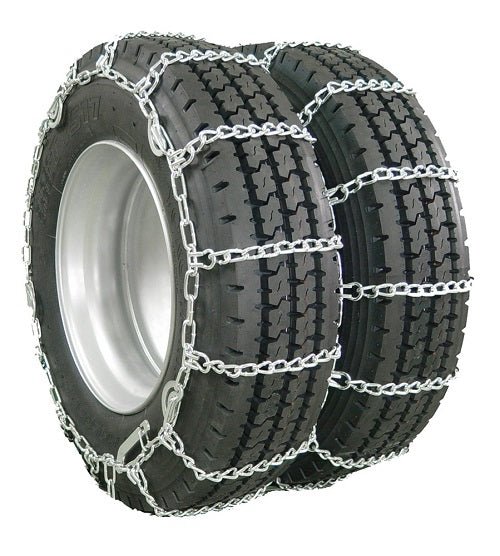
Stock your fleet with snow tire chains built for 22.5-inch commercial truck tires, along with the straps, binders, and tarps your trucks need for winter routes.